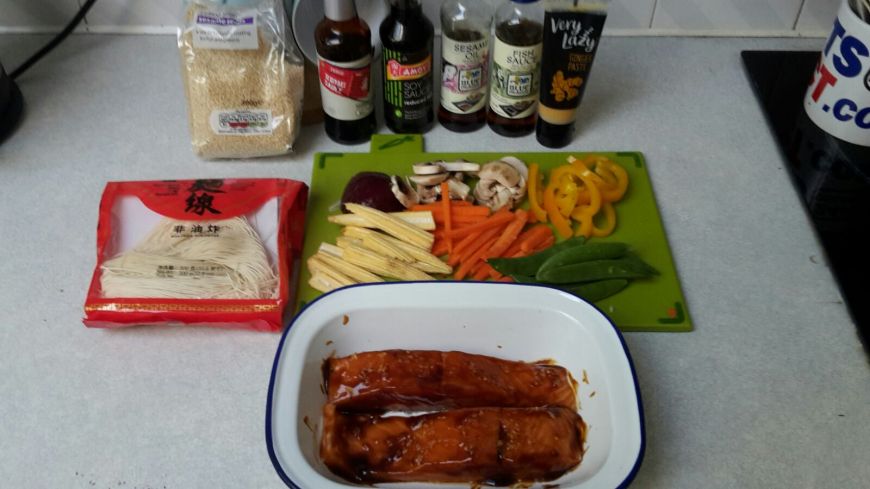
Tasty Teriyaki Salmon & Veg Noodles

Serves 2, Prep 10 Minutes, Cooking Time 10 Minutes

Ingredients
– 2 Salmon Fillets
– A selection of vegetables you find in your fridge, or a packet of stir fry veg
– 2 tbsp Teriyaki sauce
– 2 tbsp soy sauce
– 1 tsp sesame oil
– 1 tsp fish sauce
– Sesame seeds
– 1 large clove of garlic
– 1/2 tsp of ginger paste or 1cm cube of ginger
– 1 noodle nest
– Fresh coriander


  • Place the salmon in an oven proof dish and brush with half of the teriyaki sauce

  • Mix the crushed garlic and ginger. Baste half of this over your salmon

  • Leave the salmon to marinade while you prep your vegetables, or longer if you want

  • Prepare a pan of water & heat the grill

  • Heat the sesame oil in a large pan. When the oil is hot, add the onion and fry until slightly soft

  • Then place your salmon under the grill. Keep an eye on it as ours only took 10mins to cook

  • Half way through cooking add the rest of the teriyaki sauce to stop the salmon from drying out

  • Meanwhile, continue to prepare your stir fry vegetables. Once your onions have started to soften, add the rest of the garlic and ginger. Keep stirring while this fries for 1 min

  • Add the rest of your vegetables with the soy sauce and fish sauce. Once you have stirred them in add your noodles according to the instructions on the packet.

  • Once your noodles have cooked, drain them and add to the vegetables. Mix everything together. Stir in some chopped coriander and sesame seeds

  • Serve the Salmon on a bed of the noodles & veg and Enjoy!
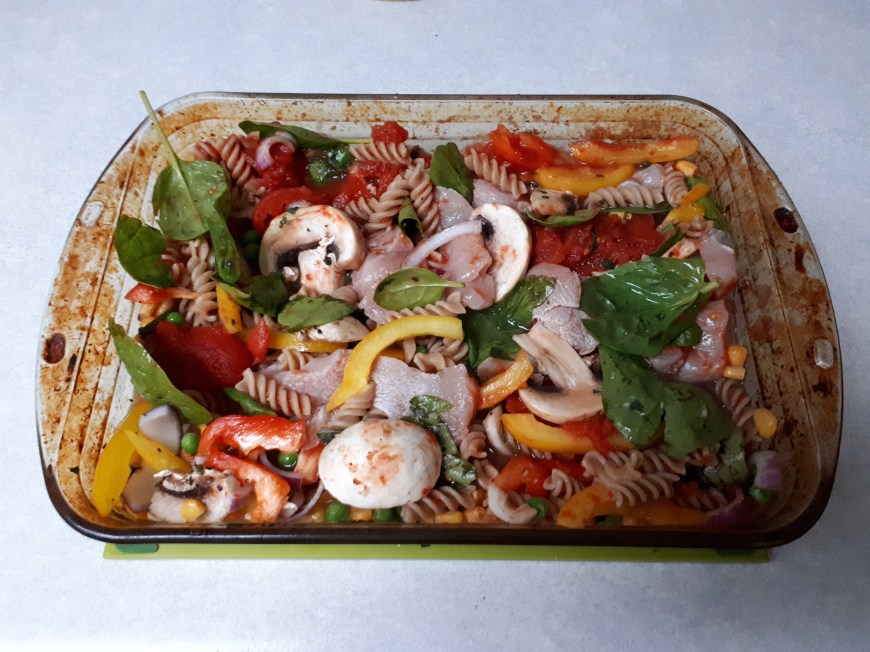
Chicken & Mediterranean Veg Pasta Bake

Try this simple recipe for a quick & tasty pasta bake packed full of veg without additives & sugar from sauce in a jar…

Prep: 5-10  minutes
Cook: 20 minutes
Serves: 2

Ingredients:

  • 2 skinless chicken breasts
  • 1 tin of chopped tomatoes
  • 1 red onion
  • 1 handful of mushrooms
  • 2 handfuls of peas
  • 2 handfuls of sweetcorn
  • 2 handfuls of spinach leaves
  • 1 yellow pepper
  • 1 red pepper
  • handful of grated cheese (mozzarella is a great lower fat alternative)
  • black pepper
  • 1 garlic glove
  • herbs of your choice: we used dried Italian mixed herb
  • 80g wholewheat pasta
  1. Pre-heat the oven to 180°c
  2. Part boil the pasta until it starts to soften slightly
  3. Whilst the pasta cooks, chop the veg to your preferred size
  4. Slice the chicken into thin strips
  5. Drain the pasta & add with the veg, tomatoes (with juice) & chicken to an oven proof dish
  6. Add the garlic and season to taste
  7. Top up with hot water (to just below top line of ingredients)
  8. Place in preheated oven, check & turn occasionally
  9. Once the chicken is cooked add cheese and return until melted
  10. Serve & Enjoy 


Healthy Eating Can Be Easy 

Kettlebell Burpee Deadlifts

Kettlebell Burpee Deadlifts (With Push Up) challenge multiple muscle groups increasing both calorie burning and muscular strength & conditioning….(Top Tips Below)

TOP TIPS

  • From your push up, engage your core to pull your knees as high & as close to you chest as possible giving you the best transition into your deadlift…
  • Confidence & commitment is key to this move, try placing cushions under your face until you’ve found your feeling.

Do We Need Carbs?…Are They All Equal?

Today we’re talking nutrition and asking the question: Do we need carbs? And are all carbs made equal?

 Firstly, ask yourself: what do you think about carbs?

– Carbs make you fat
– All carbs are bad
– Cut out carbs to lose weight
– Cut out bread, pasta, rice, cereals & potatoes for a zero carb diet

Q: Are the statements above true?    A: No, they are not strictly true

What Are Carbs And Why Do We Need Them?

Carbohydrates (CHO) are our main source of energy readily providing the body with the glucose needed to fuel nearly all bodily functions and movement.

Whilst we can function on low carb diets they are not recommended as carbs are undoubtedly our best source of energy, they can easily be broken down and converted into valuable glucose allowing our bodies to function more efficiently.

  Carbs are found in the most abundance in starchy foods such as pasta, rice, potatoes and grains, they can however also be found in many foods including fruit & veg, dairy, drinks & snack foods.
Whilst the energy content of all carbs is the same, this being 4Kcal/Gram they are far from equal in quality, eg. you already know that a bowl of oats is better  than a bowl of sugar regardless of them belonging to the same nutrient group.

 How Do I know Which Carbs To Eat?

So now we know: Carbs are essential but not all equal. It is very true that if we eat too many or the wrong ones we will indeed gain fat, and this is where they get their bad reputation from.

We rate the value of a carbohydrate on the speed at which it’s metabolised into glucose (sugar) in the blood which is then either used or stored, this can be rated on a scale of 1-100 known as the GI index  –> http://www.glycemicindex.com/foodSearch.php

  Foods scoring well on the GI index tend to be high in fibre and have a more complex molecular structure such as wholegrain, oats and vegetables.

  The foods scoring poorly are those that consist of simple molecular structures and a poor fibre content with sugar being at the top.

   Refined and sugary foods such as sweets, cakes and white pasta, rice & bread are lower in fibre and their simple molecular chains allow them to be broken down to glucose quickly.

  In order to regulate blood sugar, energy levels and hunger we should always choose high fibre, complex carbohydrates scoring well on the GI index, these include:

– vegetables
– some fruits
– wholegrains
– Oats
– Pulses
– Sweet Potato

 Simple Switches Can Make  A Difference, Try The Following:

– switch cereal to porridge
– switch white rice, bread & pasta to wholegrains & seeded bread
– switch sugary snacks and sweets for fruit, veg or a small handful of nuts

 How Many Should I Eat?
A portion of Carbs is equal to one curled palm (curl for carbs) when dry. We should aim for 5-7 of these spread throughout the day.

Your Guide To Protein

We’ve heard all kinds of feedback from our clients regarding protein, most of which highlight just how misunderstood this essential nutrient can be.

Rather than producing a list of statements longer than anyone wants to read let alone write we’ve prepared this essential guide to understanding protein.

What Is Protein? 

In short all proteins comprise of amino acids, of which there are 22, 9 of which cannot be made by the body (essential amino acids eaa) and must therefore be obtained from food, without these we cannot use protein effectively for it’s primary purpose.

 Why Do We Need Protein?

You probably know that protein allows us to repair and rebuild our muscles & soft tissues. It is true that good sources of protein containing all 9 EAA provide the building blocks to repair wear & tear and develop new tissue.

  It may be lesser know that protein is also essential for growth & maintenance in:

  • hair, skin, nails & eyes
  • forming antibodies in the immune system
  • insulin – stores energy in the muscles & regulates blood sugar
  • hemoglobin – carries oxygen in the blood

 How Much Do I Need?

This is where many myths and over consumption tend to occur. Your protein requirements are dependent on 2 factors: 1) your body weight & 2) your activity level & muscular breakdown.

 1) Inactive or Moderately Active

Adult members of this group will have an average level of daily soft tissue breakdown and therefore will be safe within the recommended daily intake set by the department of health, this being 0.8g/kg body weight.

eg if you weigh: 100kg x .08= 80g/day.

 2) Regularly Active

People exercising regularly in more vigorous sports, particularly weight lifting will experience greater soft tissue breakdown and therefore require proportionately more protein to facilitate effective recovery and the development of new tissue (bigger muscles).

 Weight lifters for example are recommended to consume 1.8-2.2g/kg during recovery which usually lasts 48 hours after training.

eg. a 100kg adult: 100kg x2 = 200g/day

 Too Much vs Too Little

Too Much: There is some evidence to suggest that unnecessarily high intakes of protein can contribute to the demineralisation of bones, high cholesterol, high blood pressure & possible kidney damage.

   Protein contains 4kcal/gram, the same as all carbs. Although these kcal are released slower than carbs excessive protein intake will still lead to increased body fat.

 In recent years protein has achieved main stream popularity with people operating on the assumption that it will help you get bigger muscles and lose weight, whilst there is truth to this it’s 100% dependent on kcal in vs kcal out and ensuring that you insight enough breakdown to the desired muscles…in other words if you are not working out effectively all of the protein in the world will not make you ‘bigger’.

Too Little: On the other hand, working out for 10 hours a day but neglecting your protein intake is more likely to make your muscles smaller and will definitely not make you bigger or stronger.

Regularly failing to meet your protein needs whether active or not can cause a disruption in your body composition, hormone and energy levels and lead to illness.

 Sources: Food vs Supplements

We’ve seen how important it is that our protein intake reflects our requirements.

 When choosing protein sources, look for the lowest fat (leanest) options to protect your protein-calorie balance.

The best sources of lean, complete proteins consistently prove to be:

  • chicken (breast, no skin)
  • turkey (breast, no skin)
  • Oily Fish (Omega 3 source)
  • chick peas (low fat, high fibre)
  • soy (low fat, high fibre)

 Protein Powder, When To Use It:

Millions fall victim to marketing campaigns every year parting with crazy money for a product they don’t understand getting little to no results.

Powders have 2 distinct appeals: 1) they are cheap & 2) they are convenient

The variety of powders available means that we cannot

generalise them, however we know that many contain

artificial sweeteners, flavouring, sugars & fats that people may be over looking.

More importantly though, they are powdered meaning that they can be digested quicker, this is only a real benefit immediately after a workout and first thing in the morning.

 Our recommendation is to save your money and invest in lean proteins which provide a slower release of amino acids into the blood.

eg. our 100kg weight lifter would benefit most from 8 evenly spaced portions each containing 25g protein through a 16 hour waking period. Perhaps they will have a protein shake upon waking & immediately after a workout equaling 2 of their portions

 There is much more that we could add to this, there is more than enough here though to ensure you can say ‘I understand Protein’.

Be A Doer!
Tom’s

 References:
Department of Health: Report on DRV for Food & Energy (2010)
WHO: Energy & Protein Requirments (1985)
NHS Choices

Aubergine & Sausage Bake: Easy & Tasty

Prep: 5  minutes
Cook: 40-45 minutes
Serves: 2

Ingredients:

1 Aubergine1 tin of chopped tomatoes
1 garlic clove1 small packet of mozzarella, sliced
6 black olives, sliced
4 pork sausages – low fat, >80% pork
chopped Basil – flavour to preference
1 ciabatta roll
black pepper

  1. Pre heat your oven to 180’C. Chop the aubergine into 2cm squares, leaving the skin on. Place into an oven proof dish and drizzle with oil. Sprinkle on some black pepper and roast in the oven for 10-15 mins until browned.

  2. Meanwhile, chop your sausages into 2cm pieces and fry in a tiny drop of rapeseed oil until they have lost their pink colour.

  3. Once the aubergine is cooked add the tinned tomatoes, crushed garlic, olives, teared basil leaves & sausage to the oven dish. Stir the ingredients and place in the oven for a further 10-15mins, until the tomatoes are bubbling and the sausages have browned.

  4. Stir the mixture in the dish. Tear up the ciabatta and place on top. Place the sliced mozzarella on top and sprinkle a some more torn basil leaves on top. Return to the oven for a further 10-15 mins until the mozzarella has melted, is bubbling slightly and is slightly brown.

Serve & Enjoy