Stop Taking Advice

Everybody knows a little about everything, right?!

And some it seems know everything about exercise & nutrition despite having no formal training or qualifications..

Let me ask you:
– would you take a medical diagnoses from a greengrocer?
– would you take your car to a baker for an MOT?

I’m hoping the answer is a resounding no, So:
 Why would you take health advice from someone unqualified to offer it??

Sadly we seem to be surrounded by people that, because they eat food and/or exercise think that they’re qualified to offer other advice…

Some Examples of Awful advice:
– Cook in Olive Oil
– Carbs make you fat
– Carbs are bad
– Fasted Cardio will lose weight quicker
– Sit ups are best for a flat stomach

The List is Endless!!

There are huge risks surrounding this not to mention that it’s unlikely to be effective because even if it’s safe this person is unlikely to have considered the practical applications of their advice, just because it works for them doesn’t guarantee it’s suited to others.

Health & Fitness professionals dedicate their lives & huge sums of £ to studying, ongoing learning & gaining the experience & qualifications allowing them and only them to safely offer you guidance.

Filter Out Other People!!!

Stop Listening to Every Person & Their Dog When it Comes to Your Health!!!

If you need help, seek a professional with the relevant qualifications & insurance to give it

Although bordering on a rant this is valuable advice and we hope that it’s already old news for you

Happy Health,

Tom’s
Are You Over Training?

It’s normal to be stiff or sore after a workout, however if the pain is severe of you’re just not healing it’s possible that you’re over training.

It’s great to be motivated and hit your training hard but not at the expense of your physical & mental health…

Training hard needs to be met with suitable rest & nutrition to fuel your recovery, without it:
– you’ll feel crap
– be at risk of injury
– won’t make progress

Signs of Over Training:
– severe muscle & joint pain
– persistent aches lasting longer than 2-3 days
– constant fatigue & tiredness
– decreased performance
– failure to progress
– stress, depression or low mood
– insomnia/poor sleep

Avoiding Over Training:
– structure training to ovoid using the same muscles on consecutive days
– if it’s sore don’t train it
– learn how to perform exercises properly
– train with your brain, not your ego
– get 8 hours sleep/night
– protein requirements more than double following resistance workouts (48 hours)
– take the time to understand & learn about nutrition & recovery
– stretch daily
– take at least 2 rest days/week
– invest time in relaxing & de-stressing
– No caffeine after lunch

Follow these key points and you’ll drastically reduce your risk of over training, however if you’re still experiencing symptoms take some rest & deload..If the symptoms persist, see your doctor.

Happy Health,
Tom’s

Strength vs Size

Often resistance or weight training is universally referred to as ‘strength training’, even by personal trainers. This is worrying as in the majority of cases the style of resistance they’re relating to is far from ‘Strength Training’…

It’s important to understand the difference.

Resistance Training
This is simply the process of applying resistance to a given movement therefore forcing the muscles to work harder, resulting in micro tears and inflammation. In time, given adequate nutrition & rest, this can result in larger and/or stronger muscles. The way in which this is done though will have a huge influence on the outcome.

Strength Training
Technically known as ‘Myofibrillar Hypertrophy, this is the neuromuscular process of increasing a muscles force production. This is done by lifting heavy weights in an explosive manor for short periods of time. In our world we often refer to this as ‘high weight, low rep’. This style of training relies on explosive contractions and adaptations within the muscles actin and myosin fibres which produce the contractions.

Size Training
Technically known as Sarcoplasmic Hypertrophy this uses metabolic overload and the accumulation of blood and sarcoplasmic fluid within a muscle to produce micro tears to the lining , the result is an increase in size & glycogen (sugar) storage but not necessarily strength. These adaptions are achieved by working the muscle under tension for longer, with a lower weight in a controlled manor. Typically this will be achieved via sets of 10+reps lasting at least 45 seconds where the individual adds voluntary muscular contraction to increase blood flow to the working muscle. We often refer to this as ‘low weight, high rep’, training for ‘pump’ or ‘metabolic overload’.

Which One Is Best
Traditionally it was believed that Sarcoplasmic Hypertrophy cannot occur without Myofibrillar as the process of lifting any weights should make you stronger right?! However new research is showing that this may be untrue and that focusing on one may result in a reduction in the other.

Sarcoplasmic Pro’s & Con’s
– quick increase in visible size
– pump feels great
– no real increase in strength
– not functional adaption – fairly useless to an athlete

Myofibrillar Pro’s & Con’s
– Functional adaption – stronger
– Great for sport
– Also makes muscles bigger
– High demand on the nervous system

We recommend using a periodised training programme that would have you working solely within each field for 6-12 weeks before transitioning to a pyramid system that utilises both for 6-12 weeks.

We will release individual articles on all 3 of these offering example training plans & rep ranges.

Regardless of which phase you’re in your results will remain dependant on applying sufficient overload to your muscles paired with adequate rest & nutrition.

Happy Health,
Tom’s

I Don’t have Time!

Time is something that we all share equally but how we use it is very different….

TIME..is undoubtedly the #1 reason we hear for people not looking after themselves, what makes us good at our job though is that we refuse to accept this EXCUSE…

Effective time management is a powerful tool and today we’re sharing some time efficient tips to help maximise your health & fitness…

Starting Point
Where is your time going?

Completing a time diary/audit may surprise you, Eg. how many minutes/day are you on Social Media or watching TV?

  • Turn off social media notifications
  • if you sleep 8 hours/night this leaves you 16 hours/day
  • an hour workout is 4% of your day, 3 workouts/week is plenty
  • the UK government recommend 300 minutes exercise/week, this can be done in as little as 10 minutes chunks when heart rate >60% max
  • Plan your week & time ahead, factor in time for food prep & workouts
  • cook in bulk and freeze for busy days
  • exercise in your lunch break
  • prepare your gym kit for lunchtime or a workout on your way home
  • active commuting: walk to work or park half way and walk the rest
  • Set daily and/or weekly goals
  • Be flexible & willing to adapt/change your plans
  • have a back up plan
  • take the stairs – always!
  • Set golden rules – eg. I MUST workout 3x/week, I will only have 2 takeaways/month
  • Find sources of inspiration: quotes, videos or idols
  • Choose a mantra eg. I’ll feel better if I exercise & eat well

We could continue for a while, but that wouldn’t be time efficient 😉

We’ll leave you by referring to our previous article that looks at setting your priorities, the key point being that your output in life is only increased by prioritising the foundation of everything you do, this being your health.
CLICK HERE

Happy Health,
Tom

Anterior & Posterior Chains

Chains are definitely lesser discussed than other anatomical functions.
Understanding your Anterior & Posterior chains though will undoubtedly help your fitness, progression & performance whilst reducing your risk of injury and skeletal imbalance.

What are they?

The Anterior Chain:
This refers to the muscles on the front side of the body including:
– Pecs
– Quads
– Core
The anterior chain plays a vital role in controlling forward movement, an essential in nearly all sports especially where direction changes are needed. Further to this your core muscles provide the foundation of all movement and power, an undeveloped or weak core will prevent you from training/progressing beyond a certain point as well as increasing the risk of falls.

The Posterior Chain:
This comprises of the muscles on the rear of the body, including:
– Hamstrings
– Glutes
– Lats
– Traps
– Rotator Cuff & Scapula Retractors
The Posterior Chain is responsible for holding us upright, without it we would flop forwards. Additionally they allow us to generate backwards force such as rowing and pulling.

How Can I Train My Chains:

Anterior Chain Exercises:
– 
Bench Press & Push Ups
– Planks, Sit Ups, Leg Raises
– Leg Extensions, Squats & Lunges

Posterior Chain Exercises:
– 
Cable Pull Throughs
– Hamstring Curls
– Rows, Lat Pull Down & Pull Ups
– Deadlift

Training For Balance:

Whatever your goals are it remains important that you have a balanced training plan unless you are training to address an existing imbalance, eg. a front chain dominant physique.

We recommend for every Anterior exercise or workout you do that you then do a Posterior exercise or workout… You could split this in many ways, an easy way to do so is to simply have 2 workout days, #1 Anterior & #2 Posterior…you could then use a 3rd session to address any muscles missed (delts & calfs etc) or run a hybrid workout that contains key lifts from each chain.

Using large, compound movements as detailed above will also aid you in recruiting the most muscle fibres and secondary muscles such as the Biceps & Triceps.

A balanced training plan and physique will not only provide the best platform for fitness, progress & performance but will also minimise your risk of developing structural issues such as pelvic tilt & shoulder instability.

We hope that this is helpful, we’re happy to help you apply this if you simply give us a shout.

Happy Healthy,
Tom’s

Challenge Yourself

Who doesn’t like the feeling of achievement?!

Setting yourself Goals & Challenges is a great way to stay motivated and something to work towards, to cap it all off at the end you get an unrivaled sense of achievement…

Your goals don’t have to be huge, they could be something as simple as improving your lap time around the park by 1 minute in the next month.

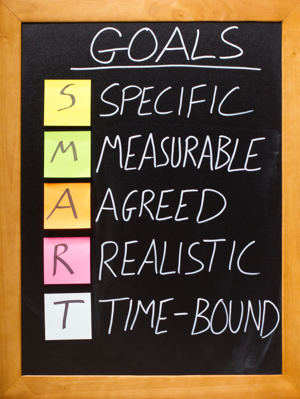
The key to setting goals & challenges is to keep them SMART…We’ve mentioned SMART goals before and undoubtedly will again, for now here is a little reminder…

Related image

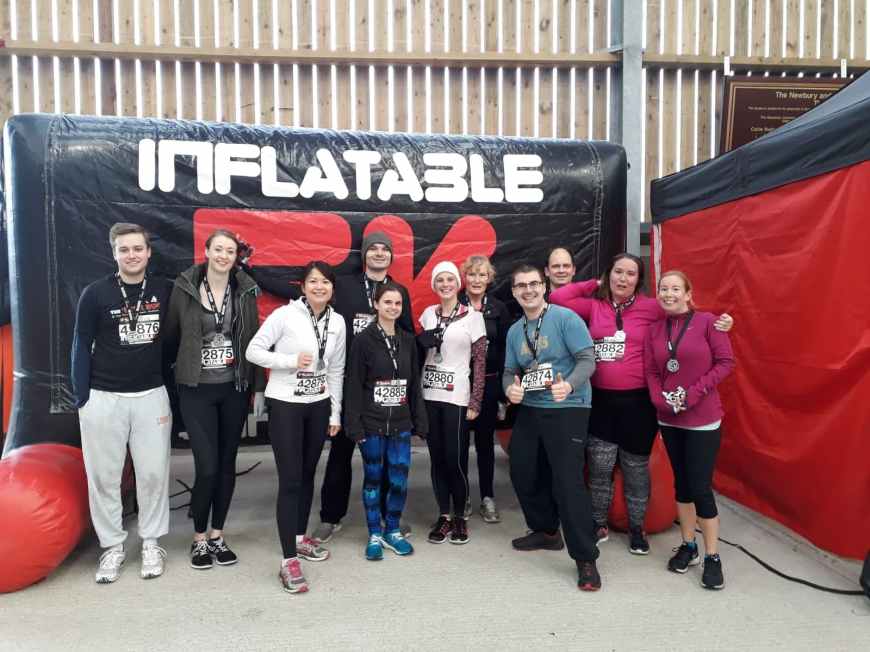
At the end of every GOAL should be a reward whether internal or external….Last Sunday that’s exactly what we got when we took some of our Boot Campers to an 5k Inflatable Obstacle Race…Not only did we all get medals and freebies but of us including our trainers felt an immense sense of achievement that already has us focused on finding our next challenge.

45267455_253280568668144_201736185851150336_n-min.jpg

What will your next challenge be?


Health Is Not My Priority

Have you ever thought this way?

We know plenty of people that have/do.
In the stress & mayhem of daily life we often find ourselves consumed by commitments restricting both our finances and time…

This often results in us ultimately neglecting ourselves as we prioritise other things such as work, family & finance over our own health & well being…

Whilst this is common and not unexpected it often has the opposite effect, by focusing on our daily priorities we forget to question why they are so and what we truly need in order to accomplish them.

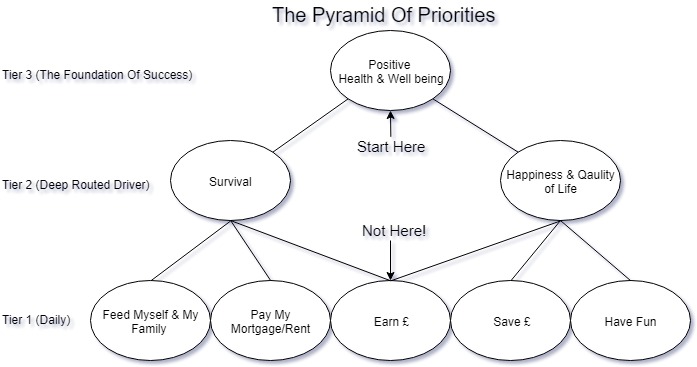
Our ‘Pyramid of Priorities’ has a familiar 1st Tier for most of us…
 STOP...and ask yourself why are these my commitments?
Untitled Diagram

The highest priority in life for every living thing is survival, this and how we feel will drive the majority of our behavior…Take it one step further and ask yourself ‘What Do I Need To Survive, NO…Flourish?’….

If your Body, Brain or Both are not functioning at optimum capacity how can you expect them to get you where you want or even NEED to be?  It’s no different to maintaining your vehicle to ensure that it transports you to where you need to be.

Today’s Top Tip: Start At The Top Of Your Pyramid.
Get this right and the rest will be considerably easier…

Happy Health,
Tom’s