Variety is the spice of life!
Vary your favourite exercises to prevent plateaus & keep your training interesting…
Today we have 10 Press/Push up variations to keep your chest and arms guessing…
Private Gyms in Reading, Pangbourne & Mortimer Mobile Personal Trainer: Reading & Berkshire

Variety is the spice of life!
Vary your favourite exercises to prevent plateaus & keep your training interesting…
Today we have 10 Press/Push up variations to keep your chest and arms guessing…
Chains are definitely lesser discussed than other anatomical functions.
Understanding your Anterior & Posterior chains though will undoubtedly help your fitness, progression & performance whilst reducing your risk of injury and skeletal imbalance.
What are they?
The Anterior Chain:
This refers to the muscles on the front side of the body including:
– Pecs
– Quads
– Core
The anterior chain plays a vital role in controlling forward movement, an essential in nearly all sports especially where direction changes are needed. Further to this your core muscles provide the foundation of all movement and power, an undeveloped or weak core will prevent you from training/progressing beyond a certain point as well as increasing the risk of falls.
The Posterior Chain:
This comprises of the muscles on the rear of the body, including:
– Hamstrings
– Glutes
– Lats
– Traps
– Rotator Cuff & Scapula Retractors
The Posterior Chain is responsible for holding us upright, without it we would flop forwards. Additionally they allow us to generate backwards force such as rowing and pulling.
How Can I Train My Chains:
Anterior Chain Exercises:
– Bench Press & Push Ups
– Planks, Sit Ups, Leg Raises
– Leg Extensions, Squats & Lunges
Posterior Chain Exercises:
– Cable Pull Throughs
– Hamstring Curls
– Rows, Lat Pull Down & Pull Ups
– Deadlift
Training For Balance:
Whatever your goals are it remains important that you have a balanced training plan unless you are training to address an existing imbalance, eg. a front chain dominant physique.
We recommend for every Anterior exercise or workout you do that you then do a Posterior exercise or workout… You could split this in many ways, an easy way to do so is to simply have 2 workout days, #1 Anterior & #2 Posterior…you could then use a 3rd session to address any muscles missed (delts & calfs etc) or run a hybrid workout that contains key lifts from each chain.
Using large, compound movements as detailed above will also aid you in recruiting the most muscle fibres and secondary muscles such as the Biceps & Triceps.
A balanced training plan and physique will not only provide the best platform for fitness, progress & performance but will also minimise your risk of developing structural issues such as pelvic tilt & shoulder instability.
We hope that this is helpful, we’re happy to help you apply this if you simply give us a shout.
Happy Healthy,
Tom’s
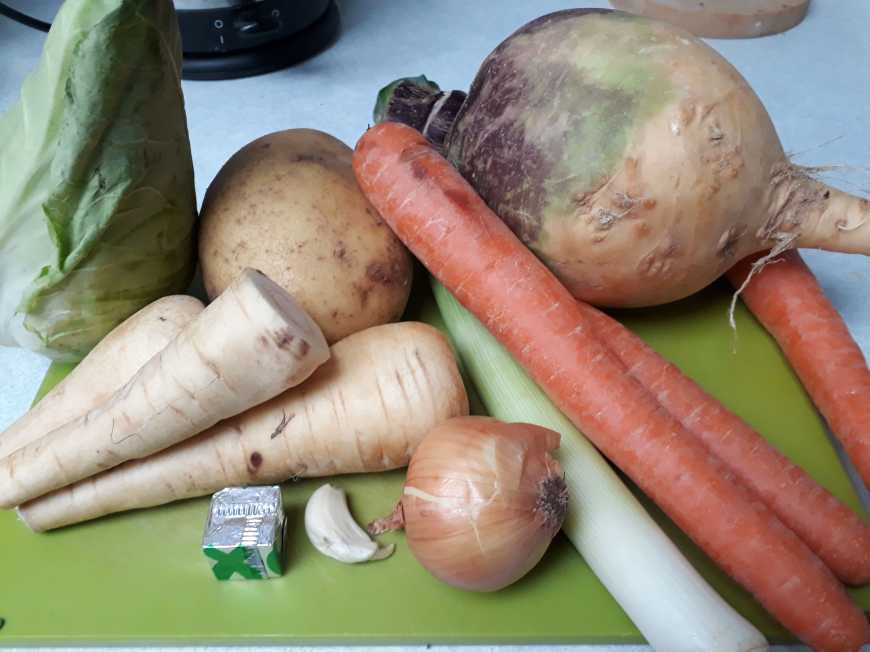
Warm up with this simple & nutritious Winter Vegetable Soup…
Serves: 4
Prep: 10 Minutes
Cook: 45 Minutes


Ingredients:
Carrot 330g
Swede 250g
Potato 350g
1 leek
1 onion
200g turnip
50g cabbage
1.5ltr veg stock
1 Garlic clove
Thyme
25g butter
Who doesn’t like the feeling of achievement?!
Setting yourself Goals & Challenges is a great way to stay motivated and something to work towards, to cap it all off at the end you get an unrivaled sense of achievement…
Your goals don’t have to be huge, they could be something as simple as improving your lap time around the park by 1 minute in the next month.
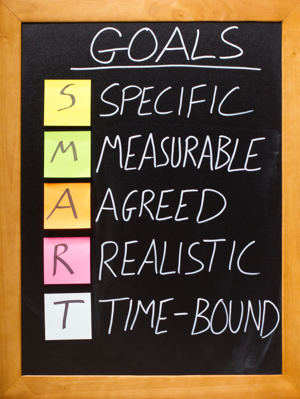
The key to setting goals & challenges is to keep them SMART…We’ve mentioned SMART goals before and undoubtedly will again, for now here is a little reminder…
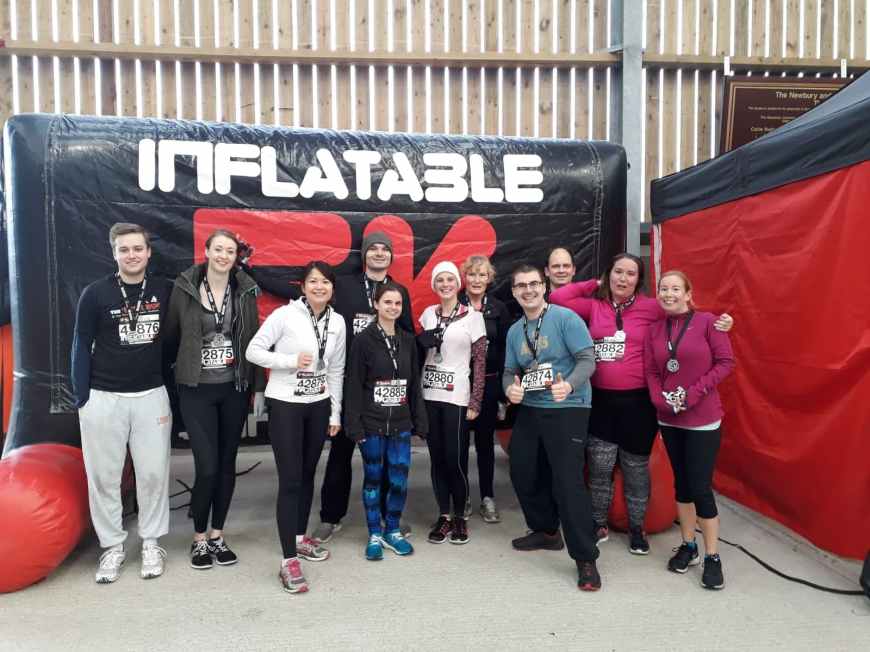
At the end of every GOAL should be a reward whether internal or external….Last Sunday that’s exactly what we got when we took some of our Boot Campers to an 5k Inflatable Obstacle Race…Not only did we all get medals and freebies but of us including our trainers felt an immense sense of achievement that already has us focused on finding our next challenge.
What will your next challenge be?
As the name suggests, Pre-Exhaust training is a system that aims to Exhaust/Fatigue a certain muscle group. This is done using an isolation exercise such as a flye or extension before moving on to a compound lift such as a press or squat.
Why Use Pre-Ehxaust?
It is important to understand that muscles work in pairs to perform movements, for example the chest pairs with the triceps to push whilst the back pairs with the biceps to pull.
With this in mind, picture the size difference between the biceps and the back, which one do you think will fatigue first? Given the biceps considerably lower size and power output its very likely that their fatigue would prevent us from fully overloading the back.
This is where Pre-Exhaust training comes in, by using an isolation exercise such as a reverse flye we can start to fatigue the back without placing stress on the biceps, this ultimately will allow us to perform a greater volume on the compound exercise.
Studies have shown that Pre-Exhaust training is an effective method for allowing a greater volume of work resulting in greater overload and muscular adaptation.
How Do I Use Pre-Exhaust?
Perform 1-2 isolation exercises on your target muscle group (3-4 sets each) before moving to 2 compound exercises (3-4 sets each).Isolation Exercises:
We love to share our clients successes with you, they say more than we ever could with words alone.
We use a range of body composition & fitness tests every 4 weeks to help track our clients progress and ensure that our programming is effective.
Below are some recent results from one of our awesome clients, she has only made small changes to her diet, started exercising 3x/week and still enjoys nights out & a social life…the results speak for themselves, being healthy doesn’t have to be hard.
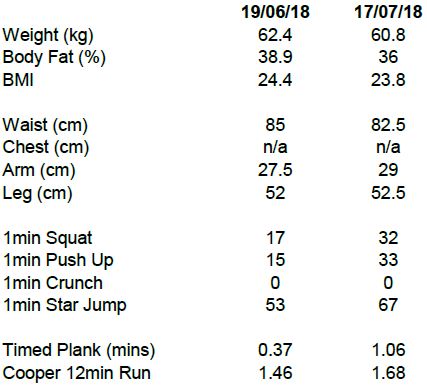
As you can see in just 4 weeks:
– her weight is down
– her waist is slimmer
– her body fat & BMI have dropped
– she has gained muscle on her legs and arms
– all of her fitness tests have considerable improvement
If all of this can be achieved in just 1 month, imagine what you could achieve over 6 months and longer.
We hope this helps to motivate you.
Tom’s

Have you ever thought this way?
We know plenty of people that have/do.
In the stress & mayhem of daily life we often find ourselves consumed by commitments restricting both our finances and time…
This often results in us ultimately neglecting ourselves as we prioritise other things such as work, family & finance over our own health & well being…
Whilst this is common and not unexpected it often has the opposite effect, by focusing on our daily priorities we forget to question why they are so and what we truly need in order to accomplish them.
Our ‘Pyramid of Priorities’ has a familiar 1st Tier for most of us…
STOP...and ask yourself why are these my commitments?
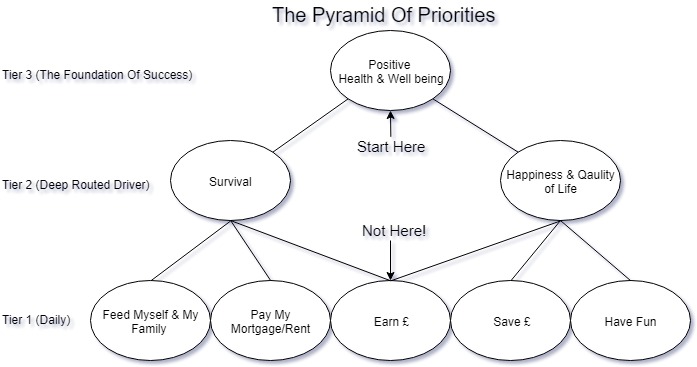
The highest priority in life for every living thing is survival, this and how we feel will drive the majority of our behavior…Take it one step further and ask yourself ‘What Do I Need To Survive, NO…Flourish?’….
If your Body, Brain or Both are not functioning at optimum capacity how can you expect them to get you where you want or even NEED to be? It’s no different to maintaining your vehicle to ensure that it transports you to where you need to be.
Today’s Top Tip: Start At The Top Of Your Pyramid.
Get this right and the rest will be considerably easier…
Happy Health,
Tom’s
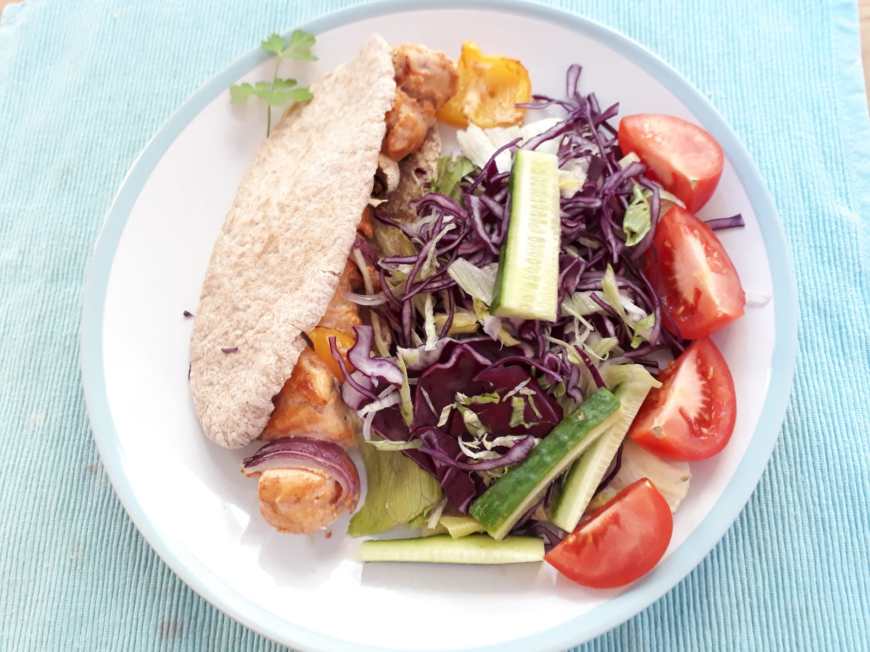
Serves 2
Prep 10-15 Minutes
Marinate >1 Hour
Cook 15 Minutes


For the Marinade
6 tablespoons natural Greek yogurt
1 tablespoon vegetable oil
1 teaspoon paprika
¼ teaspoon cumin
1/8 teaspoon cinnamon
zest from half a lemon
1 tablespoon freshly squeezed lemon
1 garlic clove
Black pepper
1 teaspoon tomato purée
For the Salad and skewers
2 chicken breasts cut into large pieces
¼ red cabbage
¼ iceburg lettuce
2 tomatoes
¼ cucumber
½ red onion
2 mushrooms
½ yellow pepper
2 pitta breads
Instructions
mix together the all of the marinade ingredients. Add the chicken pieces and cover in the marinade. Cover with foil and marinade in the fridge for at least an hour or overnight.
When ready to cook, heat the grill on a high heat and prepare the skewers.
Alternate chicken pieces with pieces of red onion, mushroom and yellow pepper.
Once assembled, place the skewers under the grill and cook for 15 mins until the chicken has browned and cooked through, turning a couple of times throughout cooking.
While the chicken is cooking, prepare the salad. Slice the red cabbage and iceburg lettuce into thin strips and chop the tomatoes and cucumber into large chunks.
In the last couple of mins of cooking the skewers place the pitta breads under the grill. Turn them over after 1 min.
Slice the pita breads along the side to make a pocket and remove the chicken and vegetables from the skewers inside the pitas.
Serve with the salad & Enjoy
We’ve put together a guide to Nutrition & Weight Management that keeps it simple whilst giving you everything that you need to know to manage your weight and eat well.
To Download, simply right click the link below and save as, alternatively left click to view online….
Enjoy, we hope that you find it helpful
Given the recent spells of hot weather it’s no surprised that we were recently asked ‘why do I need to drink more water?’.
We all know that staying hydrated is important, here’s a simple guide to why:
– your body is ~60% water
– water is used in the cleansing of the blood and removal of waste (kidneys & liver)
– water aids digestion & helps metabolise fat
– you lose water through the production of energy, cooling, breathing & numerous other functions
– the warmer you are from exercise or climate the more you sweat in an attempt to cool down
– therefore if you don’t replace it you begin to dehydrate, disrupting your bodily functions
– dehyradation can have serious effects of your liver & kidney function and lead to
– water keeps the blood runny allowing it to circulate easily, thick, dehydated blood is harder to pump which increases blood pressure and places stress on the heart
…The UK government recommends: we drink 8 glasses a day which = 2litres…
>>> If you wait until you’re thirsty you’re already dehydrated….
TOP TIP
1) Fill 4x 500ml water bottles in the morning and make sure they’re empty by bed time…take them everywhere you go….Take small sips regularly rather than occasional , large gulps…
2) You can flavour your water with sliced fruit, mint, sugar free squash & herbal tea to make it more interesting
 Tom's Health & Fitness